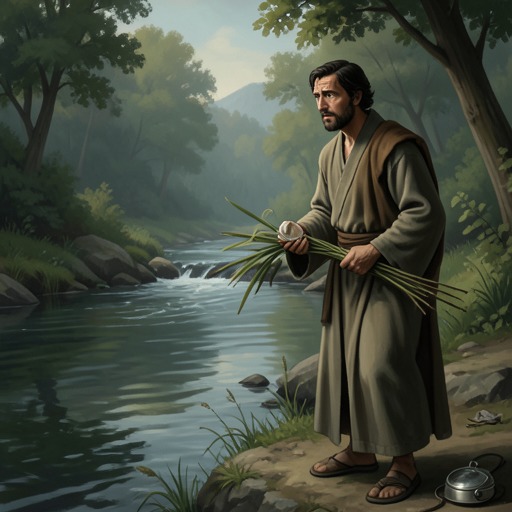
State's boat
I ChingThe vessel of the state is an image for the kingdom’s passage through crisis and the labor of establishing order. In the reading of the final hexagrams of the I Ching, a ship safely crossing a great stream figures a kingdom whose disorders have been repressed; the reverse image, a vessel not yet brought across, insists that political success remains unfinished and vulnerable.
Image and political setting
The image takes force against the account of a kingdom in disarray under the Shang rulers. The people are described as given to robbery, treachery, and violence, while nobles and officers violate the laws and crime goes unpunished. The dynasty itself is likened to someone attempting to cross a large stream without finding either ford or bank. The stream thus gives political disorder a physical shape: the community is in danger, and the route to safety is uncertain.
In the commentary on the hexagrams, the same peril becomes a state vessel’s passage across a great and dangerous stream. The image does not merely celebrate crossing. It makes political rule a collective undertaking whose success depends on bringing the kingdom through danger and then attending to what follows. A passage can be achieved without making its result secure forever.
The completed crossing
In the account of the hexagram called Completion, the vessel has been brought safely across. The kingdom’s distress has been relieved and its disorders repressed; the crossing signifies the accomplishment of the ruler’s purpose and the establishment of relative peace. Yet the image does not license complacency. The new government still needs to be consolidated, and its ruler must continue perfecting what has been achieved, quietly and with firmness and correctness.
The final line of this hexagram turns the crossing into a warning against immediately attempting it again. Its image is a driver trying to stop a carriage and a fox whose tail has become wet. After achievement, movement must for a time be hushed: renewed action could undo the success just secured. The vessel therefore stands not only for deliverance from crisis but also for the restraint required at the moment of apparent triumph.
The crossing left unfinished
The succeeding hexagram, Not Yet Completed, reverses the image: the state’s vessel has not yet crossed the dangerous stream, and the intended accomplishment remains unrealized. The book’s sequence could have ended with the completed crossing, leaving the impression that human affairs had been brought into lasting order. Instead, its ending returns the reader to struggle and renewal.
That reversal expresses the book’s account of change. Just as the seasons run through a recurring cycle, social conditions shift: order has existed, but it has also ended, and the work of establishing it begins again. The unfinished crossing therefore does not simply negate the earlier success. The figure still gives an intimation of progress, while making clear that its favorable outcome has yet to be secured.
Interpretive significance
The image connects political counsel to the I Ching’s symbolic method. Its hexagrams are presented as short, often enigmatic essays on moral, social, and political matters. King Wen interprets each whole figure, including indications of action and its good or bad fortune; the Duke of Zhou develops the significance line by line. Their words draw on the forms and language of divination, but the account distinguishes their composed interpretations from the later practice of consulting hexagrams to judge whether a contemplated course is auspicious.
The vessel’s passage consequently works as more than a prediction of a fixed political future. It frames the condition of the kingdom as a question of action: how to get through danger, how to consolidate what has been gained, and how to face the renewed work of restoring order. Its decisive lesson lies in the contrast between crossing and having crossed. Even apparent completion leaves small tasks; no completed passage guarantees an enduring peace.